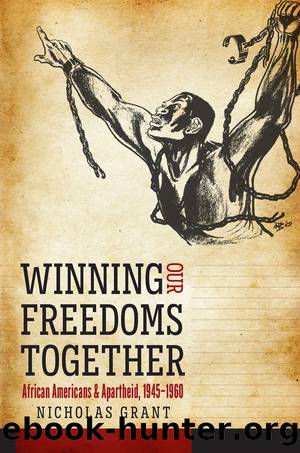
Winning Our Freedoms Together by Nicholas Grant
Author:Nicholas Grant [Grant, Nicholas]
Language: eng
Format: epub
Tags: Social Science, Ethnic Studies, American, African American & Black Studies, History, United States, 20th Century, Africa, South, Republic of South Africa
ISBN: 9781469635293
Google: VoI6DwAAQBAJ
Publisher: UNC Press Books
Published: 2017-10-18T00:59:12+00:00
Part IV Gender and Anti-Apartheid Politics
7 Motherhood, Anti-Apartheid, and Pan-African Politics
Often denied a political platform by the patriarchal structures that viewed public politics as a male domain, black women in the United States and South Africa drew on their domestic experiences in order to move beyond the private sphere and publicly challenge race and gender discrimination.1 In the decades following World War II, black women in both countries often argued that their status as mothers placed them at the center of black political and cultural life. By embracing this role, they established their position at the forefront of movements for black freedom.2 Motherhood provided a way for women to use the patriarchal gender identities assigned them to transcend male-dominated definitions of black political activism.3 Through maternalist ideals, such as the importance of the home and the care of black children, black women developed a set of mutual concerns that spanned the black Atlantic. This shared âfemale consciousnessâ amounted to a form of global black motherhood that influenced the political and cultural connections between their countries.4
Global black motherhood can be defined as a form of transnational maternalist politics based around the shared experiences of black women in white supremacist societies. Ideas relating to social position of the black mother have been historically important in terms of shaping narratives of race discrimination and black protest.5 As Patricia Hill Collins has asserted, âBlack motherhood as an institution is both dynamic and dialectical.â Noting how representations of black motherhood have been used to inform the âintersecting oppression of race, class, gender, sexuality and nation,â Collins documents how black women sometimes embraced this gender role as a means of challenging white supremacist structures.6
In the United States and South Africa motherhood was used to enforce race and gender stereotypes, while simultaneously providing a space through which black women could define themselves as self-reliant and independent. Motherhood was therefore both a burden and a potential base for the self-actualization of black women. By claiming ideals of motherhood usually reserved for whites, black women challenged negative gender stereotypes that emphasized the inherent inferiority of the black family.7 This often involved calling attention to the political significance of the domestic sphere. Exerting control over the home and providing a black space free from the intrusion of the white supremacist state represented an important resistance strategy in the black community. As bell hooks argues, the âhomeplaceâ has been an important site of resistance for African Americans. Recalling her own upbringing in Kentucky she notes, âWe could not learn to love or respect ourselves in the culture of white supremacy, on the outside; it was there on the inside, in that âhomeplace,â most often created and kept by black women, that we had the opportunity to grow and develop, to nurture our spirits.â8 For hooks, the transformation of the domestic sphere into a homeplaceâa safe space for black families through which they could escape white supremacyâwas an overt act of defiance that stressed the self-sufficiency and capability of the black family.
Download
This site does not store any files on its server. We only index and link to content provided by other sites. Please contact the content providers to delete copyright contents if any and email us, we'll remove relevant links or contents immediately.
| United States | Abolition |
| Campaigns & Battlefields | Confederacy |
| Naval Operations | Regimental Histories |
| Women |
In Cold Blood by Truman Capote(3422)
The Innovators: How a Group of Hackers, Geniuses, and Geeks Created the Digital Revolution by Walter Isaacson(3393)
Steve Jobs by Walter Isaacson(2935)
All the President's Men by Carl Bernstein & Bob Woodward(2396)
Lonely Planet New York City by Lonely Planet(2247)
And the Band Played On by Randy Shilts(2238)
The Room Where It Happened by John Bolton;(2186)
The Poisoner's Handbook by Deborah Blum(2171)
The Innovators by Walter Isaacson(2136)
Being George Washington by Beck Glenn(2130)
The Murder of Marilyn Monroe by Jay Margolis(2128)
Lincoln by David Herbert Donald(2017)
A Colony in a Nation by Chris Hayes(1956)
Under the Banner of Heaven: A Story of Violent Faith by Jon Krakauer(1829)
Amelia Earhart by Doris L. Rich(1714)
Dirt by Bill Buford(1713)
The Unsettlers by Mark Sundeen(1712)
Zeitoun by Dave Eggers(1688)
Birdmen by Lawrence Goldstone(1681)
